

“It was a golden age for Jews in Iran. In the 1950s, a religious Jew – Younes Dardashti – became a national celebrity, singing at the Shah’s palace and on the radio. In the 1960s, his son Farid became a teen idol on TV. They were beloved by Iranian Muslims. But at the height of their fame, they left the country…”
Related Grantee: Jewish Writers' Initiative Digital Storytellers Lab
Read the news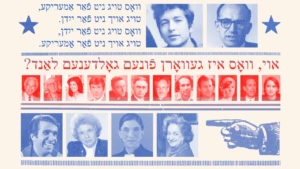
“Though right- and left-wing anti-Semitism may have emerged in different ways, for different reasons, both are essentially attacks on an ideal that once dominated American politics, an ideal that American Jews championed and, in an important sense, co-authored…a distinct strain of liberalism that combined robust civil liberties, the protection of minority rights, and an ethos of cultural pluralism. They embraced this brand of liberalism because it was good for America—and good for the Jews. It was their fervent hope that liberalism would inoculate America against the world’s oldest hatred.”
Read the news
“While we are at such a momentous and perilous time in Jewish history, we need to direct much more of our communal attention — expressed in organizational activities, public discourse, and funding — to the Jewish mainstream. American Jewry remains solidly supportive of Israel, as do most Americans. We need to draw strength from this, feel pride in it, shout about it from the rooftops, and ensure that our many and diverse communal assets are aligned in bolstering it.”
Related Grantee: SAPIR: Ideas for a Thriving Jewish Future
Read the news
“The Israelites of the Exodus were embarking on a new chapter — writing, for the first time, the next page in their history. They were actors, not subjects. The world held potential and hope. It was a fresh beginning.
Maybe we have the same fresh beginning in front of us. Perhaps history doesn’t proceed in a straight line after all, nor is it exactly cyclical. It meanders. It takes surprising turns, and there are often setbacks. While we are prepared to stand alone, venturing into the unknown as our ancestors did before us, at least on this one occasion we found we didn’t have to.”
Read the news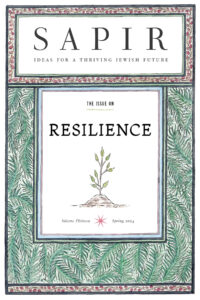
“If a picture is worth a thousand words, it can tell just as many lies. (Or many more in the age of AI.)
This is why the context of the Shani Louk photograph is so important. Its meaning 100 years from now will depend on the narrative in which it is placed, and who is telling the story. Much like Vespasian’s commemorative coin, the photograph is as evocative to those who celebrate her suffering and murder as it is to those who grieve it.”
Related Grantee: SAPIR: IDEAS FOR A THRIVING JEWISH FUTURE
Read the news
“I hadn’t thought about the film until recently as July Fourth approached this summer. For the first time, the film seems very Jewish to me. An unanticipated attack shocks us and reveals a vulnerability that we didn’t know we had. The overwhelming scope of global antisemitism can be dispiriting; each day seems to reveal a new manifestation, and each time we respond it feels increasingly like this macabre game of whack–a–mole. It can be exhausting.
It seems clear that Oct. 7, 2023 marked a turning point not only for Israel but for world Jewry and probably for the free world as well. How will future generations of Jews judge us? Were we up to the challenge?”
Read the news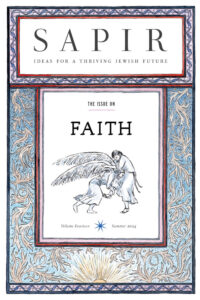
“The pain of this Tisha B’Av comes not only from the horrific events of October 7, but from the burden of our former Covenant of Fate. Here in Israel, our first non-Diaspora destination, the last stop on our exilic journey, the catastrophe of Black Shabbat forced us from the Covenant of Destiny — the clash of the east and west winds — back into the Covenant of Fate.
Now we carry both covenants, and this year, as in the past, we will get up from the ground, daven mincha, and march to the remnant of our temple, the Western Wall, and stand there to end the fast with a promise and hope that we will do everything in our power to be worthy of this house.”
Related Grantee: SAPIR: IDEAS FOR A THRIVING JEWISH FUTURE
Read the news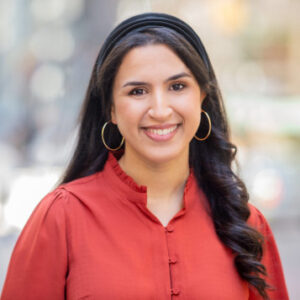
“Maimonides Fund announced that Rabbi David Wolpe and Dr. Mijal Bitton will become its inaugural Scholars in Residence, commencing in September 2024. Both Scholars are expanding their previous roles with Maimonides Fund – Rabbi Wolpe as Senior Advisor on Viewpoint Diversity Initiatives and Dr. Bitton as a Maimonides Fund Fellow – and will be undertaking major research and development projects to understand and meet this unique moment in Jewish life.”
Read the news
“Maimonides Fund, in partnership with the Constructive Dialogue Institute (CDI), is pleased to announce the launch of a new suite of programming to support viewpoint diversity and dialogue across differences within Jewish organizational settings.
Perspectives is an evidence-based learning program that distills rigorous behavioral science research into easily digestible concepts to foster openness to diverse perspectives and equip learners with the skills to engage in conversations across lines of difference.”
Related Grantee: Constructive Dialogue Institute
Read the news
“Since Oct. 7, it hasn’t been easy to be an author with ties to Israel. Book awards ceremonies turned into platforms for anti-Israel activists. Protests raged through conferences. Jewish authors had appearances canceled.
“Since Oct. 7, it hasn’t been easy to be an author with ties to Israel. Book awards ceremonies turned into platforms for anti-Israel activists. Protests raged through conferences. Jewish authors had appearances canceled.
Related Grantee: Jewish Book Council
Read the news